Artificial intelligence has moved from being a healthcare buzzword to a practical tool that is transforming medical billing operations.
Just a few years ago, many practices were wondering whether AI would eventually impact revenue cycle management. Today, the conversation has changed. The real question is whether your billing processes are keeping pace with practices that are already using AI-powered tools to improve efficiency, reduce errors, and accelerate reimbursement.
The technology is no longer theoretical. AI is actively helping billing teams identify claim issues before submission, streamline coding workflows, reduce administrative burden, and improve overall revenue cycle performance.
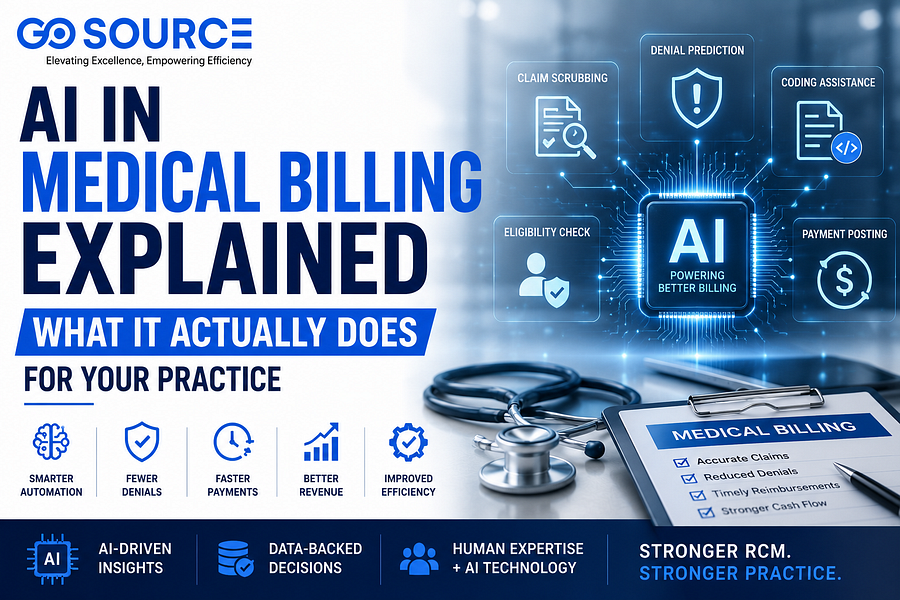
However, much of the discussion around AI in medical billing is filled with technical terms and complex explanations that do little to help practice leaders understand its real-world impact. Terms like machine learning, predictive analytics, and natural language processing may sound impressive, but what providers really want to know is simple: How does AI affect the claims, payments, and revenue flowing through my practice?
That’s exactly what we’ll explore in this guide. We’ll look beyond the buzzwords and focus on how AI is changing medical billing today, what benefits practices are seeing, and what these changes mean for your revenue cycle moving forward.
See how modern billing changes are affecting specialty practices like cardiology — Read More here.
What AI Actually Means in a Billing Context
Before exploring how AI is transforming medical billing, it’s important to understand what artificial intelligence actually means in a revenue cycle environment. AI is not a single technology. Instead, it includes several tools that help billing teams work more efficiently and make better decisions.
Machine Learning
Machine learning uses historical data to identify patterns and improve performance over time. In medical billing, this can help predict which claims are most likely to be denied based on payer behaviour, coding patterns, or documentation issues. Billing teams can then address potential problems before claims are submitted.
Natural Language Processing (NLP)
Natural language processing allows software to analyse and understand clinical documentation. By reviewing provider notes, operative reports, and other medical records, NLP tools can help identify appropriate billing codes and support more accurate coding workflows.
Robotic Process Automation (RPA)
Robotic process automation focuses on repetitive administrative tasks. Functions such as eligibility verification, claim status checks, payment posting, and other routine billing activities can be completed automatically, reducing manual workload and improving efficiency.
Predictive Analytics
Predictive analytics uses historical billing and payer data to forecast future outcomes. These tools can identify claims with a higher risk of denial, helping billing teams prioritize reviews and reduce reimbursement delays.
While each technology serves a different purpose, they all share the same goal: improving accuracy, reducing administrative burden, and helping practices optimize their revenue cycle. Together, these tools are redefining what an efficient and high-performing medical billing operation looks like.
Where AI Is Making the Biggest Difference Right Now
Artificial intelligence is already delivering measurable results across the revenue cycle. While the technology continues to evolve, several applications are helping practices improve efficiency, reduce denials, and accelerate reimbursement today.
Claim Denial Prediction Before Submission
One of the most valuable uses of AI in medical billing is identifying potential claim issues before submission. AI-powered systems analyse claims against payer requirements, historical denial patterns, and coding combinations to flag high-risk claims for review.
By catching errors early, practices can reduce denials, improve first-pass claim acceptance rates, and shorten reimbursement timelines. Instead of fixing problems weeks later, billing teams can resolve them before the claim is submitted.
Smarter Appeals Management
When denials occur, AI can help streamline the appeals process. By reviewing previous successful appeals, these systems can recommend supporting documentation, appeal language, and strategies that have worked for similar cases.
While human oversight remains essential, AI helps billing teams prepare stronger and more consistent appeals while reducing the time spent on manual research.
Coding Support Through Natural Language Processing
AI-powered coding tools can review clinical documentation and suggest appropriate CPT and ICD-10 codes based on the information recorded by providers.
These solutions do not replace certified coders, but they can improve coding efficiency, reduce repetitive manual work, and help maintain coding consistency, particularly in high-volume practices.
Automated Eligibility Verification
Insurance eligibility verification remains one of the most effective ways to prevent avoidable denials. AI-powered systems can automatically verify coverage, benefits, deductible information, and authorization requirements before appointments occur.
This reduces manual workload for staff while helping practices identify coverage issues before services are provided.
Intelligent Payment Posting
Modern AI tools are also improving payment posting workflows. In addition to processing electronic remittance advice (ERA), they can identify exceptions, match payments accurately, and flag potential underpayments for review.
The result is faster payment processing, improved accuracy, and better visibility into reimbursement performance without increasing administrative burden.
Together, these applications demonstrate how AI is moving beyond theory and becoming a practical tool for improving medical billing performance across healthcare organizations.
Where AI Is Still Developing
While artificial intelligence is transforming many areas of medical billing, it is important to recognize that the technology is still evolving and has limitations.
Complex Coding Decisions Still Require Human Expertise
AI can assist with routine coding tasks, but highly specialized coding decisions often require the knowledge and judgment of experienced medical coders. Areas such as risk adjustment coding, specialty-specific procedures, modifier selection, and complex documentation reviews still benefit from human oversight to ensure accuracy and compliance.
Payer Rules Continue to Change
Insurance companies regularly update their billing requirements, coverage policies, and authorization criteria. Although AI systems can help identify potential issues, they must be continuously updated to reflect current payer guidelines. Human review remains essential when interpreting complex or newly revised payer rules.
Patient Communication Remains a Human Responsibility
Billing is not just about claims and payments. It also involves helping patients understand their financial responsibilities and addressing sensitive billing concerns. While AI can support routine communications and automate basic inquiries, it cannot replace the empathy, judgment, and personalized approach needed in many patient interactions.
The Best Results Come From Combining AI and Human Expertise
The most effective revenue cycle operations do not rely solely on technology. Instead, they combine AI-powered efficiency with the experience of skilled billing professionals. AI can automate repetitive tasks, identify trends, and reduce administrative burden, while human experts provide the critical thinking, compliance oversight, and decision-making that complex billing situations require.
As AI continues to mature, its role in medical billing will expand. However, for the foreseeable future, successful practices will rely on a balance of advanced technology and experienced billing professionals to achieve the best financial outcomes.
What This Means for Your Practice Right Now
You do not need to be an AI expert to determine whether artificial intelligence is improving your revenue cycle. What matters is understanding the results it delivers and how those results impact your practice’s financial performance.
Questions to Ask Your Billing Team or Billing Partner
If you are evaluating your current billing processes or considering an outsourced billing partner, ask questions such as:
- Do you use AI-assisted claim scrubbing to identify potential issues before claims are submitted?
- How are high-risk claims detected and reviewed?
- What is your current first-pass claim acceptance rate?
- Is insurance eligibility verification automated or handled manually?
- Do you use analytics to identify denial trends and payer-specific patterns?
The answers can provide valuable insight into how advanced and proactive a billing operation truly is.
Metrics That Matter
The effectiveness of AI is often reflected in performance metrics. Key indicators to monitor include:
- First-Pass Claim Rate: Higher than 95% is generally a strong benchmark.
- Denial Rate: Less than 5% often indicates effective denial prevention processes.
- Days in Accounts Receivable (AR): Under 35 days suggests healthy revenue cycle performance.
- Net Collection Rate: Consistently high collection rates indicate efficient billing and follow-up processes.
If your metrics consistently fall below these benchmarks, there may be opportunities to improve workflows, technology utilization, or billing processes.
For Practices That Are Not Ready to Invest in AI Technology
Many independent and small group practices may not have the resources to build and maintain advanced AI systems internally. In these cases, partnering with an experienced medical billing company can provide access to many of the same technologies without the upfront investment.
By working with a billing partner that already uses AI-powered tools, practices can benefit from automation, denial prevention, and advanced revenue cycle analytics while allowing their internal team to remain focused on patient care and practice operations.
The Takeaway
Artificial intelligence is no longer a future concept in medical billing. It is already helping practices improve claim accuracy, reduce denials, accelerate reimbursements, and streamline revenue cycle operations.
The biggest advantage of AI is its ability to identify and prevent problems before they impact cash flow. From claim scrubbing and eligibility verification to coding support and denial prediction, AI-powered tools are helping billing teams work more efficiently while improving overall financial performance.
As healthcare billing becomes more complex, practices that embrace technology-driven workflows are gaining a measurable advantage over those still relying heavily on manual processes. Success is no longer about working harder to fix billing issues after they occur. It is about preventing those issues from happening in the first place.
GoSourceMD combines AI-powered automation with experienced billing professionals to help practices submit cleaner claims, reduce denials, and improve revenue cycle performance. By leveraging advanced technology and industry expertise, we help healthcare providers capture the reimbursement they have earned while spending less time on administrative challenges.
FAQs
Q. Is AI in medical billing reliable enough to support my revenue cycle?
Yes, AI has proven highly effective for many routine billing tasks, including eligibility verification, claim scrubbing, payment posting, and denial prediction. These tools help identify potential issues before they impact reimbursement. However, complex coding decisions and situations that require clinical judgment still benefit from experienced billing and coding professionals. The strongest revenue cycle strategies combine advanced technology with human expertise.
Q. Will AI replace medical billing professionals?
AI is designed to support billing teams, not replace them. It can automate repetitive administrative tasks and improve efficiency, allowing billers and coders to focus on higher-value responsibilities such as denial management, complex coding, payer communication, and patient support. Human oversight remains essential for maintaining accuracy, compliance, and quality.
Q. How can I tell if my billing partner is truly using AI?
The best way to evaluate a billing partner is by looking at performance metrics rather than marketing claims. Ask about their first-pass claim rate, denial rate, and days in accounts receivable. Strong results in these areas often indicate that effective automation and advanced billing technologies are being used to improve revenue cycle performance.
Q. Can small practices benefit from AI-powered medical billing?
Absolutely. Many smaller practices gain access to AI-driven billing tools through outsourced medical billing partners. This allows them to take advantage of advanced automation, denial prevention, and revenue cycle optimization without the cost of purchasing and maintaining the technology themselves.